
We all worry about the perils of an uncertain future, and what we can do in anticipation of it. Top of mind worries include how the pandemic could play out, the competition for power between the Democratic and Republican parties in the United States, Russia’s invasion of Ukraine, China’s belligerence toward the United States, climate change threats, the future dynamism of the U.S. economy and the increasing effects of digital data on every dimension of society.
To address my worries about the future, I created three scenarios for how the United States could change over the next twenty-eight years focusing on the major issues with the widest ranges of possible outcomes. Together, the three scenarios provide a framework for anticipating the future. If all the futures for the United States were represented as points in a two-dimensional figure (below), there are infinite possibilities. If the points near the edge of the figure represent extreme plausible scenarios, then I can approximate or blanket the possible futures for my anxiety issues by selecting three points — i.e., scenarios — at the edge.
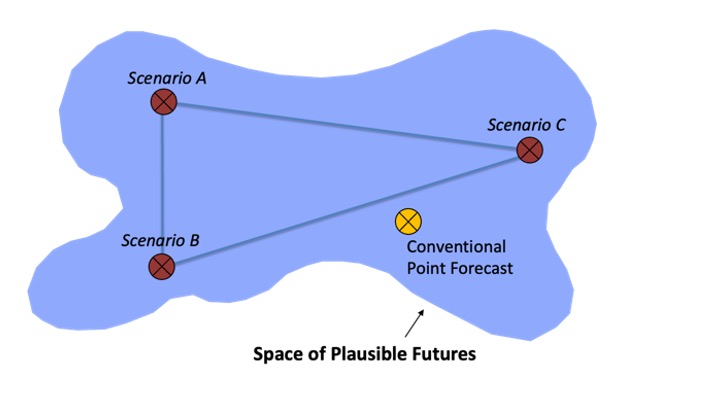
In the middle of 2022 I completed development of the scenarios. The article “Three Scenarios of the United States’ Future – 2022 to 2050” was published in the management journal Strategy & Leadership, Vol. 50, No. 6, in November 2022.
Over the coming weeks I will present the three scenarios, discuss the major forces and dynamics, and highlight implications. In this blog I introduce the scenarios.
Identifying the Issues to Focus on
To identify the dominant issues that will shape the United States, I reviewed what experts were saying would be the forces and dynamics that will shape the United States’ future out to 2050. From this set of high-impact issues, I pinpointed those where experts were projecting the widest ranges of possible outcomes in thirty years. This group of high-impact, high-uncertainty issues would be the focus of the scenarios.
Note: The dominant issues with narrower ranges of possible outcomes in 2050 weren’t discarded but included as the common backdrop for the scenarios.
The high-impact, high-uncertainty issues included a mix of demographic, environmental, social, economic, political, and geopolitical forces and drivers, and based on their influence on each other, the issues clustered into four central scenario dynamics. Two extreme outcomes, representing the range of expert opinions of possible outcomes in thirty years, were determined.
- How will the role of the US government evolve over the next 28 years? At one extreme, the U.S. government expands its role in society by enacting big programs that focus on domestic social and energy/climate problems. U.S. federal government spending expands from 21% of GDP in 2019 to 30% in 2050. At the other extreme, the U.S. government focuses on security and economic issues without expanding the role and size of the U.S. government. U.S. federal government spending still expands from 21% of GDP in 2019 to 25% in 2050.
- How strong will be the US economy over the next thirty years? At one extreme, U.S. GDP growth averages 1.0 percent per year from 2021 to 2050. At the other extreme, U.S. GDP growth averages 2.0 percent per year from 2021 to 2050.
- What will be China’s strategy in the struggle against the U.S. to shape the international order? At one extreme, China aggressively confronts the U.S. position in Asia. China moves to assert sovereignty over Taiwan, dominate the Asia region, and remain the center of global trade. At the other extreme, China is passively aggressive toward the U.S., playing the long game to become the world’s economic superpower and refraining from provoking the U.S. China seeks to overwhelm Taiwan peacefully.
- What will be global energy use and greenhouse-gas (GHG) emissions from 2021 to 2050? At one extreme, the world achieves its goal of “net-zero” emissions of CO2 by 2050 (from 40 GtCO2 in 2020) by slowing the demand for energy and using less hydrocarbons in energy supply. At the other extreme, the world develops extensive new renewable energy supplies to maintain strong global economic growth but continues to rely on large volumes of hydrocarbons through 2050. CO2 emissions in 2050 are the same as they were in 2020: 40 GtCO2.
Presenting the Three Scenarios
A scenario is the integration of outcomes for the four central dynamics by a plausible narrative. Three scenarios were selected to span the possible outcomes of the four dynamics for the United States. Each dynamic extreme is represented in at least one scenario.
Three Scenario Logics of the United States’ Future — 2022 to 2050 | |||
Dynamic: | Scenario A “Socially Divided” | Scenario B “Security United” | Scenario C “Economy Focused” |
| US Gov’t Role | Expanded | Limited | Limited |
| US Economy | Medium growth | Weak growth | Strong growth |
| China toward US | Aggressive | Aggressive | Passive Aggressive |
| Energy Use | High consumption of hydrocarbons | Low consumption of hydrocarbons | High consumption of hydrocarbons |
The following scenario narratives are three coherent yet very different pictures of the future.
Scenario A: “Socially Divided”
The development that defines the “Socially Divided” scenario is China’s brutal nationalism and displacement of the United States as the world’s number one superpower. China’s leaders leverage the strengths of China’s controlled economy to displace the U.S. in political and cultural influence and economic connections in Asia, Africa, and Latin America.
In 2024 China’s government shows its new power position in Asia by invading Taiwan, with Taiwan quickly surrendering.
China’s takeover of Taiwan creates a split between the China-led economic sphere and the U.S.-led sphere as the U.S. and its allies attempt to punish it with economic and trade sanctions.
U.S. society is deeply divided on social and political issues, and the world watches as the government stumbles from crisis to crisis. Democrats and Republicans remain far apart in their views of government’s priorities, and political compromises are rarely reached. Control of the U.S. federal government bounces between the Democrats and Republicans, and the country reels from attempted policy changes when the other party gains control in Washington. The Democrats succeed in implementing laws to expedite the development of energy renewables, eliminate use of hydrocarbons, and provide more financial aid to low-income families. Neither party can develop a foreign policy strategy that is popular with the electorate. However, the electorate is clear on one foreign policy issue: no confrontation with China over Taiwan.
U.S. federal government spending increases from 21 percent of GDP in 2019 (before Covid) to 30 percent in 2050. Military spending as a percent of GDP declines from 3.2 percent of GDP in 2019 to 1.9 percent in 2050.
Global economic growth is modest from 2021 to 2050, averaging just 2.7 percent/yr. OECD countries (or advanced economies) grow 1.0 percent/yr, while non-OECD countries — the emerging economies — grow 3.5 percent/yr in the period. Rates for the U.S. and China are 1.3 percent/yr and 3.1 percent/yr, respectively.
While China has the largest economy in the world and is growing faster than the U.S., China’s economy is slowing down because of energy supply problems, government bureaucracy and corruption and a shrinking work population. Other than China, emerging economies struggle to meet the needs of their growing populations.
The electrification of power generation worldwide is enabled by enormous investments in China and India in nuclear energy, solar and wind energy, and battery technology. However, the electrification of the world’s economy is expensive, and not smooth. Power outages are frequent. Energy security and costs remain significant problems throughout the scenario.
World energy consumption increases from 570 EJ/yr in 2020 to 725 EJ/yr in 2050. China, India, and other emerging economies depend on energy from hydrocarbons to sustain their economic growth.
By 2050, the United States economy no longer outperforms other advanced economies; and the U.S. standard of living is level with the EU standard of living. Poverty levels in the country have declined but the percent of households receiving federal housing assistance has grown from about 6 percent in 2016 to 12 percent in 2050; unemployment is running high, and life expectancies in the country are below those of most EU countries.
Scenario B: “Security United”
The signature event of the “Security United” scenario is the global depression from 2026 to 2035 brought on by China’s collapsing economy. After global supply chains and energy markets were severely disrupted by the pandemic and Russia’s invasion of Ukraine, inflation rose and many advanced economies, including the U.S., began implementing protectionist policies, exacerbating economic dislocations in China and the rest of the world.
Early in the scenario the U.S. and other advanced economies implemented energy and climate-change policies to electrify the world’s energy system and decarbonize the global economy. However, the restriction of oil, gas and coal supplies was causing shortages and wildly fluctuating prices. Power outages were also becoming frequent even in the advanced economies because of insufficient investment in renewable energy and electricity-transmission-line capacities.
China reaffirmed its intention to assert sovereignty over Taiwan. In response the U.S. and western Pacific allies increased their military supplies to Taiwan, solidified economic and political treaties with each other and initiated economic sanctions against China and Chinese companies.
In the U.S., federal government spending as a percent of GDP was increasing, having increased from the pre-pandemic 21 percent of GDP in 2019 to 24 percent of GDP in 2025 because of mandatory Medicare and Social Security costs for the aging population, military priorities and new programs for low-income groups and climate-change mitigation.
In 2026 the world descended into a depression. China’s economy and India’s economy were hit hard by the depression, while the U.S. suffered the least among the major economies. From 2021 to 2050 global GDP growth averages just 0.9 percent/yr. OECD countries (or advanced economies) grow 0.7 percent/yr, while non-OECD countries (the emerging economies) grow 1.0 percent/yr in the period. Rates for the U.S. and China are 1.1 percent/yr and 0.4 percent/yr, respectively.
U.S. society quickly united on the issues of the economy, security and the China threat, and both Democrats and Republicans proposed to cut federal government spending across the board, suspend all but essential health, safety and environmental regulations on infrastructure projects, but expand payments to the unemployed. After two years of negative growth, the U.S. economy begins to recover. Total U.S. federal government spending remains at 25 percent of GDP from 2026 to 2050.
The global depression results in world energy consumption decreasing from 570 EJ/yr in 2020 to 480 EJ/yr in 2050. Because of the drop in energy consumption and capacity increases in renewable energy generation and electricity transmission, the world almost achieves its net zero CO2 emissions by 2050 goal: CO2 emissions drop from 40 GtCO2 in 2020 to 5 GtCO2 in 2050.
In 2050 the U.S. is still the number one superpower and continues to maintain a strong military presence in the western Pacific. American multinationals have decoupled their supply chains from China, and America reigns supreme in digital technology development.
While China’s economy hasn’t kept pace with the U.S. economy, it is beginning to grow again. Amid the depression, China had affirmed the objective to unite peacefully with Taiwan. However, a new generation of China leaders is emerging that is nationalistic and bellicose.
Scenario C: “Economy Focused”
China and the U.S. remain neck and neck in the global competition for economic power throughout the “Economy Focused” scenario. In the race to develop next-generation technologies, the U.S. remains the most powerful country in the digital realm. China’s economy continues to grow despite a shrinking work force, a lack of innovation compared to dynamic American, European and Asian societies and China’s forceful use of economic-coercion tactics.
China’s leaders remain focused on expanding and strengthening China’s economic links to the rest of the world and asserting China’s dominance of Asia. China maintains its goal to integrate Taiwan peacefully.
In the 2020s Taiwan develops new strong treaties with Japan, South Korea, India and the United States and builds up its military forces. At the same time, Taiwan seeks to strengthen the island’s social and economic ties with China. Pro-China political parties on the island are growing stronger.
U.S. society unites on the priorities of the economy, energy security and national security following Russia’s attack on Ukraine. Democrats and Republicans generally agree on strengthening the global economic system, the World Trade Organization and expanding access to the U.S. market. Both also support a new energy/climate policy that would make the country resilient to the climate, economic and social threats facing the country.
The U.S. economy is dynamic and continues to grow, despite an expanding federal government budget. U.S. federal government spending increases from 21 percent of GDP in 2019 to 25 percent in 2050. Federal military spending drops as a percent of GDP from 3.2 percent of GDP in 2019 to 2.5 percent in 2050.
From 2021 to 2050 the global economy is resilient and strong. Global GDP growth averages a strong 3.8 percent /yr. OECD countries (or advanced economies) grow 1.8 percent/yr, while non-OECD countries (the emerging economies) grow 5.0 percent/yr in the period. Rates for the U.S. and China are 2.0 percent/yr and 3.8 percent/yr, respectively.
After the Glasgow Climate Change meeting in 2021 and Russia’s invasion of Ukraine, the advanced economies accomplish an “about-face” on eliminating the use of natural gas and oil and limiting the use of nuclear energy. A global system for carbon tariffs is implemented after the EU, China, India, and U.S. agree to support a system and the WTO adjusts its rules.
Because of strong economic growth in the emerging economies, world energy consumption increases from 570 EJ/yr in 2020 to 845 EJ/yr in 2050.
Greenhouse gas emissions remain high through 2050 but are beginning to decline rapidly because of advances and implementation of carbon capture and storage systems at the end of the scenario.
By 2050 China’s economy is twice as large as the U.S. economy, and India’s economy is substantially larger than the U.S.’s. U.S. economic power is still equal to China’s because of the strength of U.S. trade relations, its superior financial system, and the leadership of U.S. multinationals in many high-tech sectors and the service industries. The U.S. leads the world in terms of household wealth. The U.S. dollar is still the dominant global currency.
Taiwan remains independent but China has expanded its commercial and social ties in the country. Public opinion in Taiwan supports increasing the social and economic alignment of China and Taiwan.
 Plausible Outcomes